Designing a Flexible Training Platform
Designing a flexible training platform for travel and hospitality clients—balancing bespoke branding and content needs with a coherent, scalable learner experience.
Client:
Mogul
Role:
Lead Designer
Year:
2018 - 2019
The Challenge
Mogul offers a productized training platform that is adapted for each client, primarily within the tourism, travel, and hospitality industries. While every implementation needed to reflect each client’s brand, structure, and content, the underlying experience also had to remain usable, maintainable, and scalable across deployments.
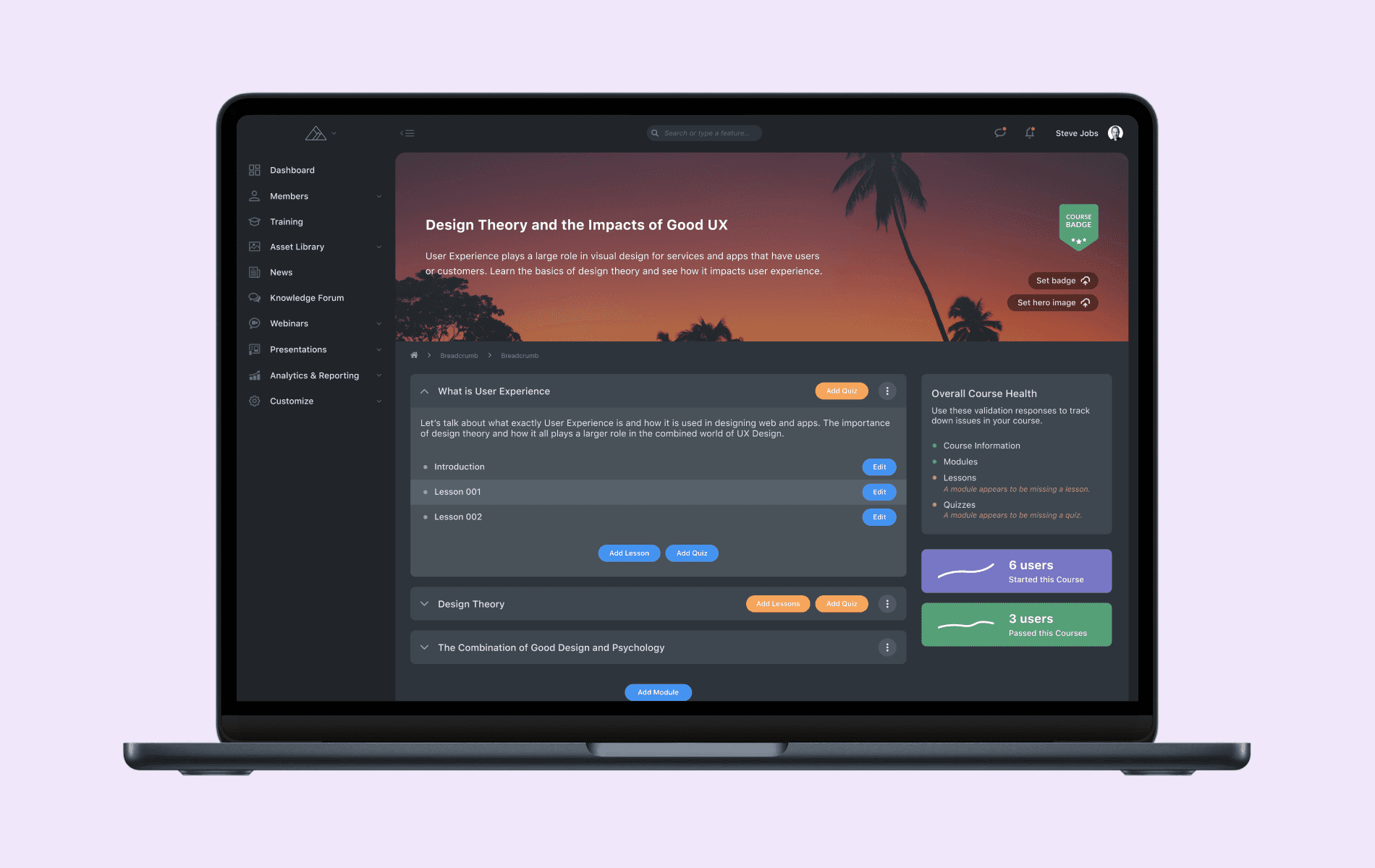
At the core of the platform were tools for building and delivering courses, with additional modules—such as Knowledge Forum, Presentations, and Webinars—available as add‑ons depending on client needs. The challenge was to design a system that could support this level of flexibility while still feeling like a single, cohesive product rather than a collection of one‑off custom builds.
Process
As the sole designer, I introduced a structured design cycle into the company, moving Mogul from ad‑hoc delivery toward a repeatable, user‑centred process. Each engagement began with a comprehensive kickoff to understand business objectives, client requirements, target learners, and success metrics, usually paired with an audit of existing training materials and competitor research to spot gaps and opportunities.
From there, I mapped the parallel tracks of work: the learner‑facing app and the admin dashboard that clients used to manage content and programs. Low‑fidelity wireframes explored core flows—such as course enrollment, lesson consumption, and assessment completion for learners, and course creation, organization, and reporting for admins—before evolving into high‑fidelity prototypes that integrated client branding, visual design, and real content. I stayed involved through implementation, collaborating closely with development and performing design QA to ensure the shipped experience matched the intent.
Solution
The resulting platform treated Mogul as a configurable product rather than a series of custom one‑offs: a stable core for courses and assessments, with modular features like Knowledge Forum, Presentations, and Webinars that could be toggled on and tailored per client. The learner experience emphasized clarity and momentum—progressive disclosure of content, clear next steps, and a visual language that could flex to client brands without compromising usability.
On the admin side, the redesigned dashboard made it easier for client teams to structure programs, manage content, and understand how learners were engaging. Information architecture and layout were simplified to surface the most important actions first, reducing the cognitive load for non‑technical training managers and making it more feasible to run ongoing initiatives without design or engineering support. Together, these improvements created a platform that felt powerful but approachable, capable of supporting diverse training initiatives across travel and hospitality while still behaving like one coherent product.
Key takeaways
This work reinforced a few core principles for productizing bespoke training:
A modular product core with clearly defined add‑ons allows for high client customization without fragmenting the user experience.
Treating branding as a layer on top of consistent interaction patterns helps balance client identity with a predictable learner journey.
Investing in admin experience is as important as learner experience when adoption depends on non‑technical teams creating and maintaining content.
Introducing a clear design process—research, iteration, validation, and implementation support—can meaningfully elevate both product quality and client outcomes in a small team environment.